
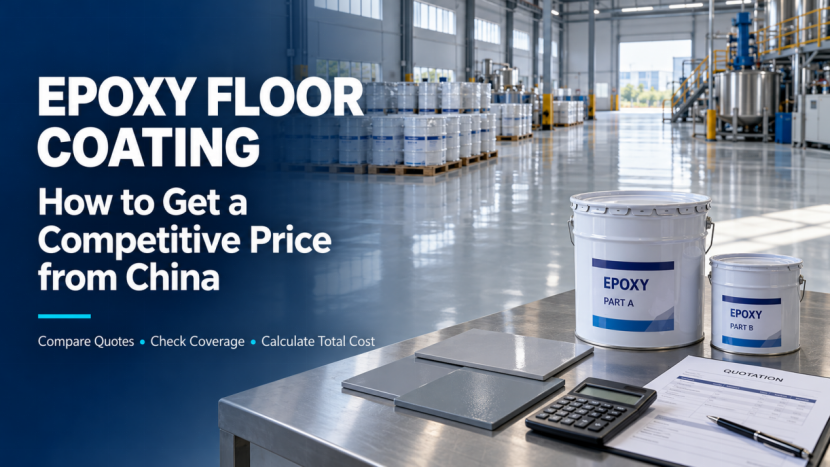
Practical sourcing considerations include product specifications, material consumption, supplier verification, packaging and total landed costs for international buyers.
HUIZHOU, China — November 5, 2026 —[KOREWIRE] — International buyers sourcing epoxy floor coatings from China can improve purchasing decisions by evaluating product specifications, material consumption and total delivery costs rather than relying solely on quoted prices. Jincheng Resin highlights several factors that distributors, contractors and private-label brands can consider when comparing manufacturers and negotiating supply agreements.
Epoxy floor coating quotations can vary significantly depending on product formulation, application requirements, packaging and shipping arrangements. A lower price per kilogram does not necessarily translate into lower project costs if a product requires additional material, extra coating layers or higher application quantities to achieve the required finish.
Define Product Requirements Before Requesting Quotes
The first step in comparing suppliers is identifying the intended application and coating requirements. Epoxy flooring systems can include primers, pigmented roller coatings, self-leveling body coats and protective topcoats, each serving a different purpose.
Buyers should prepare a written specification covering the application environment, expected traffic, required coating layers, target dry film thickness, finish, color and packaging preferences. Environmental conditions, including application temperature and humidity, should also be considered.
Specific operational requirements, such as forklift traffic, exposure to cleaning chemicals and required curing times, can help manufacturers recommend appropriate formulations.
Selecting a coating based on actual application requirements can also help buyers avoid unnecessary specifications while maintaining the performance needed for the project.
Compare Complete Two-Component Systems
Many epoxy floor coatings use a two-component system consisting of resin and hardener. However, supplier quotations may differ in what they include.
For example, a quoted 20-kilogram package may represent a complete resin-and-hardener kit or resin alone, with the hardener priced separately.
To avoid misleading comparisons, buyers should confirm the product grade, intended application layer, included components, mixing ratio and net usable weight. They should also establish whether the mixing ratio is measured by weight or volume.
Other important quotation details include container sizes, price per kilogram or complete kit, applicable delivery terms and quotation validity.
Clear documentation makes it easier to compare offers and reduces the possibility of unexpected costs after an order is placed.
Evaluate Material Costs per Square Meter
Price per kilogram is useful for purchasing calculations, but material consumption provides a more practical basis for comparing coating costs.
The estimated material cost per square meter can be calculated by multiplying the product price per kilogram by its consumption rate per square meter.
For example, a coating priced at $2.30 per kilogram with a consumption rate of 0.70 kilograms per square meter has an estimated material cost of $1.61 per square meter. Another coating priced at $2.65 per kilogram with consumption of 0.55 kilograms per square meter costs approximately $1.46 per square meter.
These illustrative figures demonstrate why a higher unit price does not always result in a higher application cost. Comparisons should account for equivalent dry film thickness and performance requirements.
Actual consumption can also vary because of surface porosity, concrete conditions, application methods and material waste. For complete flooring systems, buyers should calculate the requirements for primers, body coats and topcoats separately.
Review Technical Data and Coverage Claims
Solids content and material density can influence coating coverage and overall consumption.
Buyers should determine whether a manufacturer’s solids figures refer to weight solids or volume solids. Volume solids are particularly relevant when calculating dry film thickness, while mixed density helps convert the required coating volume into material weight.
Technical data sheets should provide information about recommended wet film thickness, expected dry film thickness, mixed density, volume solids and estimated consumption.
These figures should be reviewed together rather than treated as independent performance indicators. Application conditions, working time, finish requirements and substrate suitability also influence product selection.
Verify Manufacturing Capabilities and Documentation
Evaluating a supplier requires more than reviewing its website or quoted prices. Buyers can request information about production processes, incoming raw material inspections, batch testing and retained samples.
Product-specific technical data sheets, safety data sheets and traceable batch numbers can help establish a clearer understanding of manufacturing and quality-control procedures.
For larger orders, buyers may also consider a factory video inspection or independent third-party assessment. Trading companies can provide useful services, including supplier coordination, product consolidation and export handling, so purchasing decisions should consider the complete service offering.
Jincheng Resin, which operates through jinchengresin.com, produces epoxy, polyurethane and polyaspartic floor coating systems. Its product range includes a two-component, 100% solids, zero-VOC moisture vapor barrier primer and a low-temperature-curing polyaspartic topcoat. The company also supports original equipment manufacturing (OEM) and private-label production.
As with other manufacturers, buyers evaluating its products can request technical documentation, batch records and samples before making larger purchasing commitments.
Request Volume-Based Pricing
Instead of negotiating around a single order quantity, buyers can request a pricing structure covering trial orders, expected repeat purchases and larger consolidated shipments.
Maintaining the same formulation and packaging across different quantity levels allows buyers to identify how production volume affects the quoted price.
Manufacturers may also offer different commercial arrangements based on production scheduling, cumulative purchasing volumes or scheduled deliveries.
However, buyers should consider product shelf life, storage capacity and expected demand before committing to larger quantities. Forecasts should be presented as estimates rather than guaranteed purchasing commitments.
Consider Packaging and Transportation Costs
Packaging requirements can affect the total cost of small and medium-sized orders. Custom containers, printed labels, artwork preparation and multiple packaging variations may introduce additional charges or minimum order quantities.
Buyers can request separate quotations for standard packaging, custom labels, printed containers, protective wrapping and pallet arrangements.
Transportation costs should also be included in supplier comparisons. A competitive factory price may become less attractive after export handling, freight, insurance, customs clearance, import duties and inland delivery are considered.
Comparing quotations under the same International Commercial Terms (Incoterms) and named delivery locations can help buyers calculate a more consistent landed cost.
Current safety data sheets for both components should be obtained, and freight forwarders should confirm applicable transportation requirements based on the actual product formulation and shipment details.
Test Samples Before Placing Bulk Orders
Product samples provide an opportunity to evaluate coating performance under representative application conditions.
Buyers can record material consumption, mixing ratios, working time, curing behavior and surface finish during sample testing. Other relevant considerations include leveling, hiding power, adhesion and resistance to cleaning chemicals used in the intended environment.
For projects requiring formal performance verification, buyers can arrange testing through an appropriate laboratory using agreed test methods.
Once a sample is approved, the product code, formulation version and packaging specifications should be documented. Written acceptance criteria can also help establish expectations for subsequent bulk orders and any proposed formulation changes.
Focus Negotiations on Overall Purchasing Value
Manufacturers may have more flexibility when buyers simplify packaging, reduce unnecessary color variations, consolidate shipments and provide predictable production schedules.
Requesting multiple quotations for the same approved formulation can help identify potential savings without compromising technical requirements.
Buyers should also document payment milestones, production lead times, inspection arrangements, quotation validity and procedures for handling nonconforming products.
Ultimately, sourcing epoxy floor coatings from China involves evaluating more than the initial quotation. Comparing complete kits, calculating material costs per square meter, reviewing technical specifications and assessing landed costs can help international buyers make more informed purchasing decisions.
A competitive sourcing arrangement combines appropriate product performance, transparent commercial terms and consistent supply rather than focusing exclusively on the lowest quoted price.
Media Contact
Jincheng Resin
Website: https://www.jinchengresin.com/
Email: daisy@bestepoxyresin.com
Location: Huizhou, Guangdong, China


