
Key Takeaways
- Making a stroke with a non-conforming driver in any sanctioned competition – stroke play or match play – results in disqualification, not just a stroke penalty.
- Rounds played with non-conforming equipment are ineligible for handicap posting under the World Handicap System, which affects far more than just tournament play.
- Carrying a non-conforming club in the bag carries no penalty on its own – the violation is triggered only when a stroke is made with it.
- The player, not the manufacturer or the committee, bears sole responsibility for confirming equipment conformance before competition begins.
- Wondering whether a specific driver is USGA-conforming before a tournament? Affordable Golf Courses breaks down exactly what to check and why the manufacturer’s word alone isn’t enough.
Most amateur golfers assume that equipment rules are someone else’s problem – something referees sort out on tour. But at the club championship level, the state qualifier, or even a Saturday stroke play round where a handicap score gets posted, conformance is entirely the player’s responsibility. And the consequences of getting it wrong go well beyond a two-stroke penalty.
One Club Can End Your Whole Tournament
The scenario plays out more often than most golfers realize: a player shows up with a driver they bought online, maybe one a YouTube ad promised would add 30 yards and fix a slice. They play well. They’re in contention. Then someone raises a conformance question – and the round is over before the scorecard is signed.
That’s not a hypothetical. Under USGA Rule 4.1a, making a stroke with a non-conforming club in competition triggers automatic disqualification. No warning. No stroke penalty option. One swing, tournament over. Knowing exactly how and where that penalty applies is the kind of rules knowledge that separates prepared competitors from golfers who learn the hard way.
What Makes a Driver Non-Conforming
Golf equipment is non-conforming when it fails to meet the official specifications established jointly by the USGA and The R&A. For drivers, the tested limits are precise:
- Coefficient of Restitution (COR): Maximum 0.830 – this caps the trampoline effect of the face
- Characteristic Time (CT): Maximum 257 microseconds (with an 18-microsecond tolerance) – a related measurement of face spring during impact
- Head Volume: Maximum 460cc
- Moment of Inertia (MOI): Maximum 5,900 g·cm² about the vertical axis
- Club Length: Maximum 48 inches under the general Rules of Golf; note that Model Local Rule MLR G-10, effective January 1, 2022, allows committees at professional or elite amateur competitions to set a shorter limit of 46 inches
A driver that exceeds any one of these limits is non-conforming, full stop. Normal wear and tear does not render a previously conforming club non-conforming – but deliberate alterations to the head, face, or shaft can.
Key Specs the USGA Enforces
CT and COR receive the most attention because they directly measure how a face performs at impact. Drivers engineered specifically to exceed those thresholds – sometimes marketed as non-conforming for extra distance – are the clearest-cut cases. A club can also fail on volume or MOI without any obvious visual tell, which is why independent testing, not eyeballing, is the only reliable standard.
Not Listed Does Not Equal Automatically Illegal – But Confirmation Is Still Your Job
Absence from the USGA conforming driver heads list does not automatically mean a club is non-conforming. A manufacturer may simply never have submitted the model for testing, or a submission may still be pending. The club could be perfectly within spec – but unverified.
For tournament purposes, that distinction is largely academic. Most competition committees and rules officials treat a club not on the list and a non-conforming club as functionally the same thing. The burden of proof falls on the player, not the committee.
When Local Rules Require List Presence for Elite Events
At USGA-sanctioned amateur events, state qualifiers, and higher-level competitions, local rules frequently require that all equipment appear on the official conforming list. At that level, a manufacturer’s conformance claim carries no weight. The list is the standard – if the club isn’t on it, it doesn’t play.
Stroke Play DQ: The Rule and Its Narrow Exceptions
Under Rule 4.1a, any stroke made with a non-conforming club in stroke play results in disqualification from the round. This applies whether the player knew the club was non-conforming or not – intent is irrelevant. Disqualification is the only available outcome because the potential advantage gained is considered too significant for the score to stand.
When a Stroke With a Non-Conforming Club Doesn’t Trigger DQ
There are two narrow interpretive exceptions worth knowing:
- Provisional ball scenario: If a stroke is made with a non-conforming club but that stroke never counts in the player’s score – for example, a provisional ball that is ultimately abandoned – disqualification does not apply, because the non-conforming stroke had no effect on the score.
- Stroke-play playoff: If a non-conforming club situation arises only during a playoff, the disqualification applies only to the playoff itself. Any prizes or finishes secured in the main competition are retained.
These are narrow interpretations. In the overwhelming majority of real competitive situations, a stroke with a non-conforming club means an immediate DQ.
Match Play Penalties Are Just as Severe
A common misconception is that match play operates under a more forgiving penalty structure – that a hole loss or concession might be the outcome instead of disqualification. That’s not the case here.
Disqualification From the Match – Not a Stroke Penalty
In match play, making a stroke with a non-conforming club results in disqualification from the match – not a hole penalty, not a loss of the current hole. The entire match is forfeited. This is the same severity as stroke play, applied to the match-play format. An opponent who is aware of the violation and chooses to enforce it ends the match immediately.
Disqualified Rounds Don’t Count for Handicap
The consequences extend beyond the scoreboard. Under the World Handicap System, scores recorded while using non-conforming clubs or balls are not acceptable for handicap posting. A round played with a non-conforming driver – even a casual club round where no formal competition is involved – is technically ineligible to be posted as a handicap score.
Handicap integrity is built on the premise that every posted score was played under the Rules of Golf, including equipment rules. In practice, this is rarely audited at the club level – but the rule is unambiguous, and at clubs where committee members pay attention, it can become an issue.
You’re Solely Responsible for Your Clubs
The USGA is explicit on this point: the player bears sole responsibility for ensuring their clubs conform to the Equipment Rules. There is no grace period for discovering a non-conforming club mid-round. There is no shared liability with the manufacturer if a marketed conforming driver turns out not to be listed. The moment that club enters the competition bag, it’s the player’s problem to have verified.
How to Verify Conformance Before Competition
Verification takes about five minutes and removes all ambiguity:
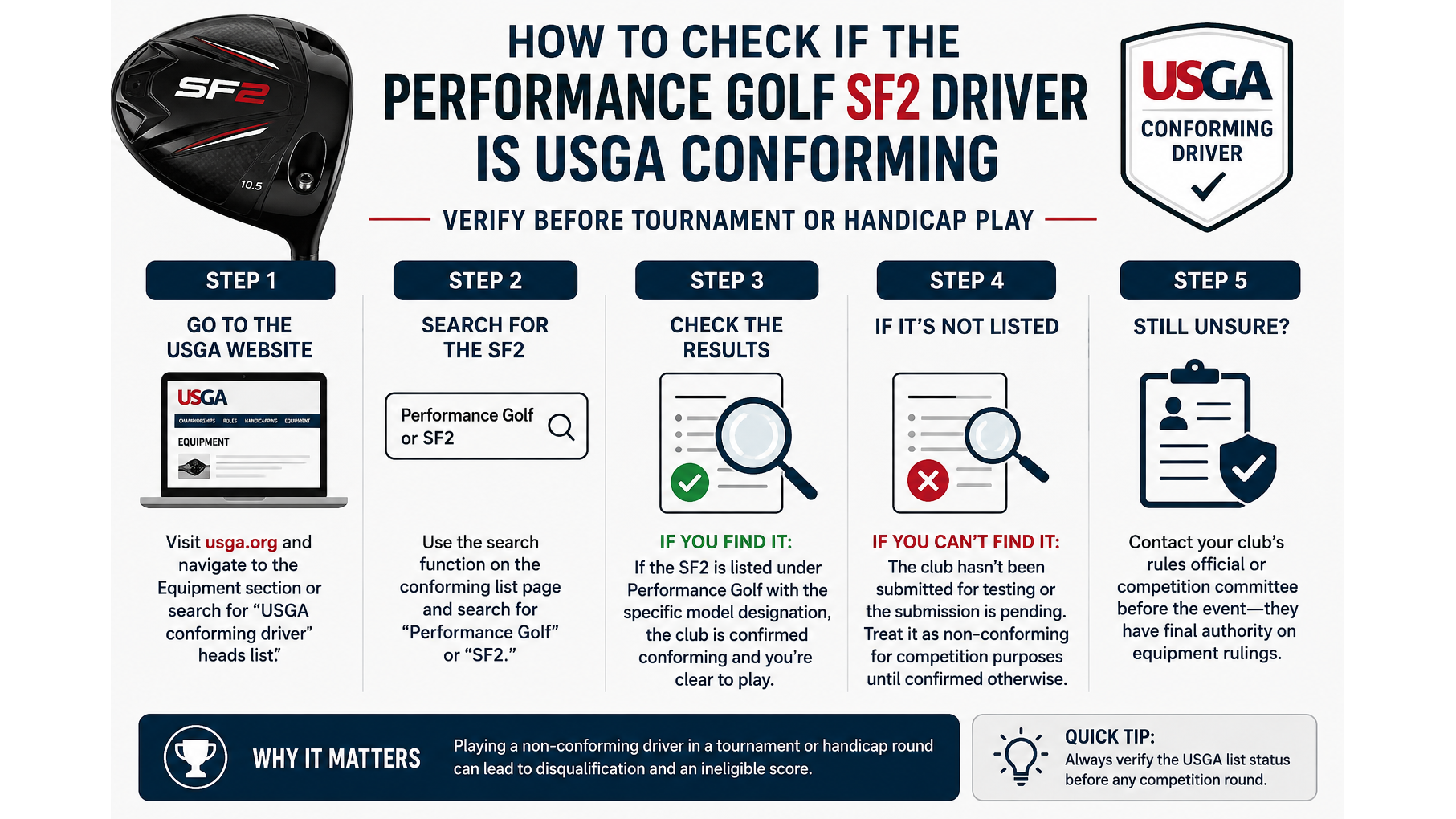
- Go to usga.org and navigate to the Equipment section – search for the USGA conforming driver heads list.
- Use the search function to look up the manufacturer name and specific model designation.
- If the driver appears on the list with the correct model name, conformance is confirmed.
- If it doesn’t appear, treat it as non-conforming for competition purposes – contact the manufacturer to ask about submission status, or check back closer to the event.
- When in doubt, bring the question to the club’s competition committee or rules official before the round begins. They have final authority for local events.
Carrying a Non-Conforming Club: No Penalty, But It Still Counts Toward Your 14
There is no penalty for carrying a non-conforming club in the bag, provided no stroke is ever made with it. If a player realizes mid-round that a club may be non-conforming and has not yet made a stroke with it, they must refrain from using it. The club still counts toward the 14-club limit for the remainder of the round and cannot be removed from the bag to make room for a replacement.
Check the USGA List Before You Tee Off – Not After
The pattern that leads to DQs isn’t malicious – it’s complacency. A golfer buys a driver, the manufacturer’s page says it’s tournament legal, and that’s where the due diligence ends. In stroke play and match play alike, a manufacturer’s conformance claim is a starting point for research, not a substitute for it.
Five minutes on usga.org before a club championship is the kind of preparation that distinguishes competitors who finish from those who don’t. Check the specific model designation, not just the brand name. Confirm before putting it in the bag – not after the first tee shot of the opening round. For a practical example of why this matters, Affordable Golf Courses examined the conformance question around the Performance Golf SF2 driver – a real-world case study in why manufacturer claims and USGA list status can diverge, and what that means for tournament players.
For more course and equipment guidance built around what everyday golfers actually need to know, visit Affordable Golf Courses, where practical resources help amateur players make smarter decisions on and off the course.
Affordable Golf Courses
8767 3rd Ave
Pleasant Prairie
Wisconsin
53158
United States


