DONGGUAN, GUANGDONG, CHINA, August 24, 2026 /EINPresswire.com/ — The global athletic footwear market is undergoing a major transformation in 2026. Footwear brands no longer evaluate component suppliers purely on low-cost labor or basic assembly capabilities. Instead, product managers and biomechanical engineers prioritize advanced polymer science, energy return performance, and sustainable manufacturing practices. As athletic footwear technology advances, identifying the top tier of component suppliers becomes vital for brand competitiveness. Evaluating the Top 10 Sports Insole Manufacturers requires looking beyond high factory output. Modern footwear sourcing directors need partners that deliver superior cushioning, environmental compliance, and rapid customization capabilities.
In this evolving ecosystem, Asian supply chains have shifted from traditional OEM manufacturing to high-tech research and production hubs. Leading manufacturers across the region invest heavily in automated molding, clean gas-injection processes, and eco-friendly chemical formulations. These advancements allow global footwear brands to achieve strict sustainability targets while enhancing athletic performance metrics. Consequently, footwear brands require a clear framework to navigate this changing landscape and select tier-one insole suppliers that match their product roadmaps.
The Top 10 Sourcing Matrix: 5 Benchmark Criteria Defining Industry Leaders
To establish an objective benchmark for global footwear brands, industry experts evaluate top-tier insole manufacturers through five core operational criteria. These standards separate standard suppliers from true innovation partners in the global footwear supply chain.
First, physical foaming capabilities mark the primary technical threshold. Premier manufacturers have replaced traditional chemical blowing agents, such as AC chemical foaming agents, with Supercritical Fluid physical foaming technology. This method uses inert gases like nitrogen or supercritical carbon dioxide to create uniform microcellular structures. As a result, the process eliminates toxic organic solvents while delivering superior lightweight resiliency and compression resistance.
Second, biomechanical engineering and zonal density customization determine a supplier’s design capabilities. Elite manufacturers engineer multi-density foam matrices within a single insole unit. For example, high-impact heel zones receive dense absorption compounds, while forefoot areas incorporate ultra-resilient foams to maximize energy return.
Third, environmental integrity drives raw material selection. Tier-one suppliers integrate certified recycled polymers and eco-friendly foam materials into their production lines. They maintain full traceability and comply with zero-VOC emission standards to support global carbon reduction goals.
Fourth, rapid prototyping and custom formula engineering dictate development velocity. Modern brands require suppliers that can translate digital biomechanical CAD designs into functional physical samples within tight timelines.
Fifth, global regulatory compliance and supply chain resilience ensure market accessibility. Top manufacturers hold rigorous certifications, including ISO quality management standards, REACH chemical safety compliance, and SATRA laboratory testing approvals. These qualifications guarantee seamless delivery to international retail markets.
Deep-Dive into Next-Gen Sports Insole Foam Technologies
Material performance sits at the heart of athletic footwear innovation. In 2026, three advanced foam technologies define high-performance sports insoles across running, basketball, and outdoor categories.
Supercritical EVA (SCF EVA) represents a major leap forward in lightweight cushioning. By injecting gas into ethylene-vinyl acetate under supercritical conditions, engineers create ultra-fine cell walls. This unique microcellular structure yields an exceptionally low density without sacrificing structural integrity. Consequently, SCF EVA sports insoles deliver an energy return exceeding 65 percent while maintaining excellent collapse resistance over prolonged athletic use.
Expanded Thermoplastic Polyurethane (ETPU Boost) technology offers another breakthrough for high-impact sport applications. ETPU consists of closed-cell elastic beads that absorb heavy mechanical shock and bounce back instantly. Furthermore, ETPU maintains dynamic thermal stability, ensuring the insole retains its flexibility and cushioning performance across extreme cold or warm climates.
Additionally, high-rebound breathable polyurethane (PU) formulations serve as a core standard for daily performance footwear. Open-cell PU foams promote continuous air circulation beneath the foot, actively managing moisture and heat buildup. When paired with anti-microbial topcover fabrics and deep U-shaped ergonomic heel cups, these insoles offer superior arch support, stabilize body alignment, and reduce muscle fatigue.
Industry Case Study: How Foamwell Exemplifies the Tier-1 Manufacturing Standard
Examining top-tier manufacturing standards requires a closer look at industry pioneers who successfully integrate material science with scalable production. Foamwell exemplifies this benchmark, operating at the forefront of technical foam manufacturing and global insole exports.
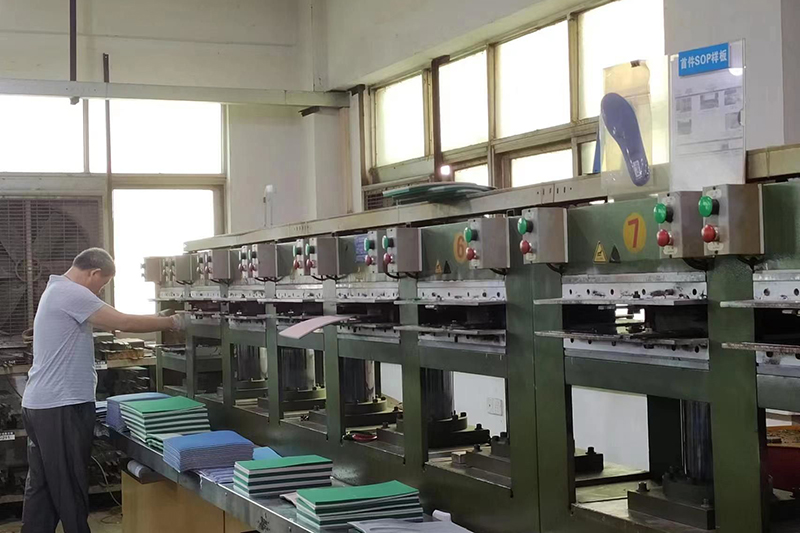
Through continuous research and development, Foamwell has mastered proprietary Supercritical Fluid physical foaming techniques across both EVA and ETPU polymer platforms. The company produces high-performance sports insoles that deliver exceptional energy return, lightweight comfort, and zero chemical residue. By replacing hazardous chemical blowing agents with clean gas-injection systems, the manufacturer sets a clean production standard for the athletic footwear industry.
Furthermore, the company excels in providing flexible custom solutions for global footwear brands. Foamwell’s engineering team works directly with brand developers to tailor foam densities, mold geometry, and functional surface layers. Whether creating specialized arch supports for orthotic alignment or dual-density cushioning for athletic shoes, the manufacturer executes rapid 3D prototyping and custom sampling.
Sustainability remains another core pillar of the operation. Foamwell integrates eco-conscious processing, recycled foam compounds, and breathable PU formulations that comply with strict international environmental regulations. Combined with large-scale production capacity, ISO-certified quality management, and efficient export handling, the company serves as an ideal OEM and ODM development partner for international footwear brands seeking high-performance insole solutions.
The Buyer’s Audit Playbook: How to Evaluate Your Insole Supply Partner in 2026
Selecting an insole manufacturer requires a structured auditing process. Footwear sourcing teams should follow a four-step evaluation method during supplier assessments.
Step 1 focuses on facility inspections. Sourcing directors must verify whether the factory operates genuine physical gas-injection foaming machinery or relies on legacy chemical lines. Observing clean-room equipment and automated production units reveals true technological capability.
Step 2 involves comprehensive material testing. Sourcing teams should request independent lab reports verifying rebound percentage, compression set resistance, tear strength, and anti-odor longevity under dynamic stress tests.
Step 3 covers regulatory and ESG verification. Buyers must audit REACH documentation, SATRA performance test certificates, and GRS certifications to confirm environmental compliance for global distribution.
Step 4 executes an OEM development trial. Sourcing managers should evaluate the supplier’s communication response time, 3D sampling precision, and agility in making chemical adjustments during sample revisions.
Strategic Sourcing Outlook & Partnering for Innovation
Navigating the global footwear supply chain in 2026 demands a balance between technical innovation, sustainability, and production efficiency. As brand expectations evolve, tier-one manufacturers must continuously elevate their polymer capabilities and custom solution support. Evaluating suppliers through objective biomechanical and environmental metrics ensures long-term product success in competitive retail markets.
Global footwear brands seeking to enhance athletic performance and advance sustainable product development can explore technical formulations, custom insoles, and OEM/ODM capabilities at https://www.foam-well.com/.
Foamwell Limited
Foamwell Limited
+ +86 13549380132
email us here
Legal Disclaimer:
EIN Presswire provides this news content “as is” without warranty of any kind. We do not accept any responsibility or liability
for the accuracy, content, images, videos, licenses, completeness, legality, or reliability of the information contained in this
article. If you have any complaints or copyright issues related to this article, kindly contact the author above.

Media gallery