
Key Takeaways
- Newman University’s Radiologic Technology program follows a structured 5-semester timeline where clinical rotations begin in the very first semester — not after year one.
- Graduating students accumulate roughly 1,400 clinical hours across multiple facilities, well above the JRCERT minimum standard of 1,200 hours.
- The Kansas Promise Scholarship can cover tuition, fees, and books for eligible Kansas residents — with a two-year live-and-work requirement after graduation.
- Entry-level rad tech salaries in Kansas typically range from $40,000 to $58,000, with experienced technologists earning between $77,000 and $85,000 or more annually, and top earners potentially exceeding $100,000.
- Keep reading to see exactly how the clinical rotation timeline unfolds semester by semester — and what to do right now to strengthen an application.
Not many career paths offer real hands-on patient experience before the end of the first semester in college. Radiologic Technology is one of them. It is a 21-month associate’s degree program that blends classroom instruction, lab time, and supervised clinical rotations from day one. For anyone in Kansas weighing a healthcare career, it is one of the most direct routes to a stable, well-paying job in a growing field.
Near-Perfect Job Placement — Why Rad Tech Grads Don’t Wait Long
Job hunting after graduation is stressful for most people. For rad tech graduates, it barely exists as a problem. Jeff Vaughn, Program Director of the Radiologic Technology program at Newman University, put it plainly during a recent information session: “All of our students here in the last five years have got jobs — 100% of them.”
That statistic reflects a real workforce gap. The job outlook for radiologic technologists in Kansas is projected to grow by 6.1% between 2020 and 2030, and employers are actively competing for qualified graduates. Some facilities hire students as student technologists while they are still enrolled — essentially paying them to train before they even cross the stage at graduation.
What makes this possible is the structure of the clinical component itself. By the time students finish the program, clinical sites have already had months to evaluate work ethic, reliability, and skill — which is why job offers often arrive before the final semester ends. Vaughn describes the clinical experience as “a two-year job interview” — and the data backs that up.
What the 21-Month Program Actually Looks Like
Most associate’s degrees wrap up in four semesters. This one takes five. That difference is intentional and meaningful, and understanding why sets the right expectations for anyone seriously considering this path.
Five Semesters, Not Four: Why the Extra Term Matters
The Radiologic Technology program runs on a fall-spring-summer-fall-spring schedule. The summer semester in the middle is not filler — it is an active clinical term designed to expose students to rural healthcare settings and a broader range of patient populations.
The reason the program cannot simply be compressed is rooted in clinical requirements. Students must demonstrate 51 competencies — real procedures performed on real patients. Because patient volume cannot be manufactured on demand, the program needs the full 21 months to ensure every student reaches competency across a wide enough range of procedures and clinical environments. Rushing that process would compromise both student readiness and patient safety.
Clinicals Start Semester One — Not Later
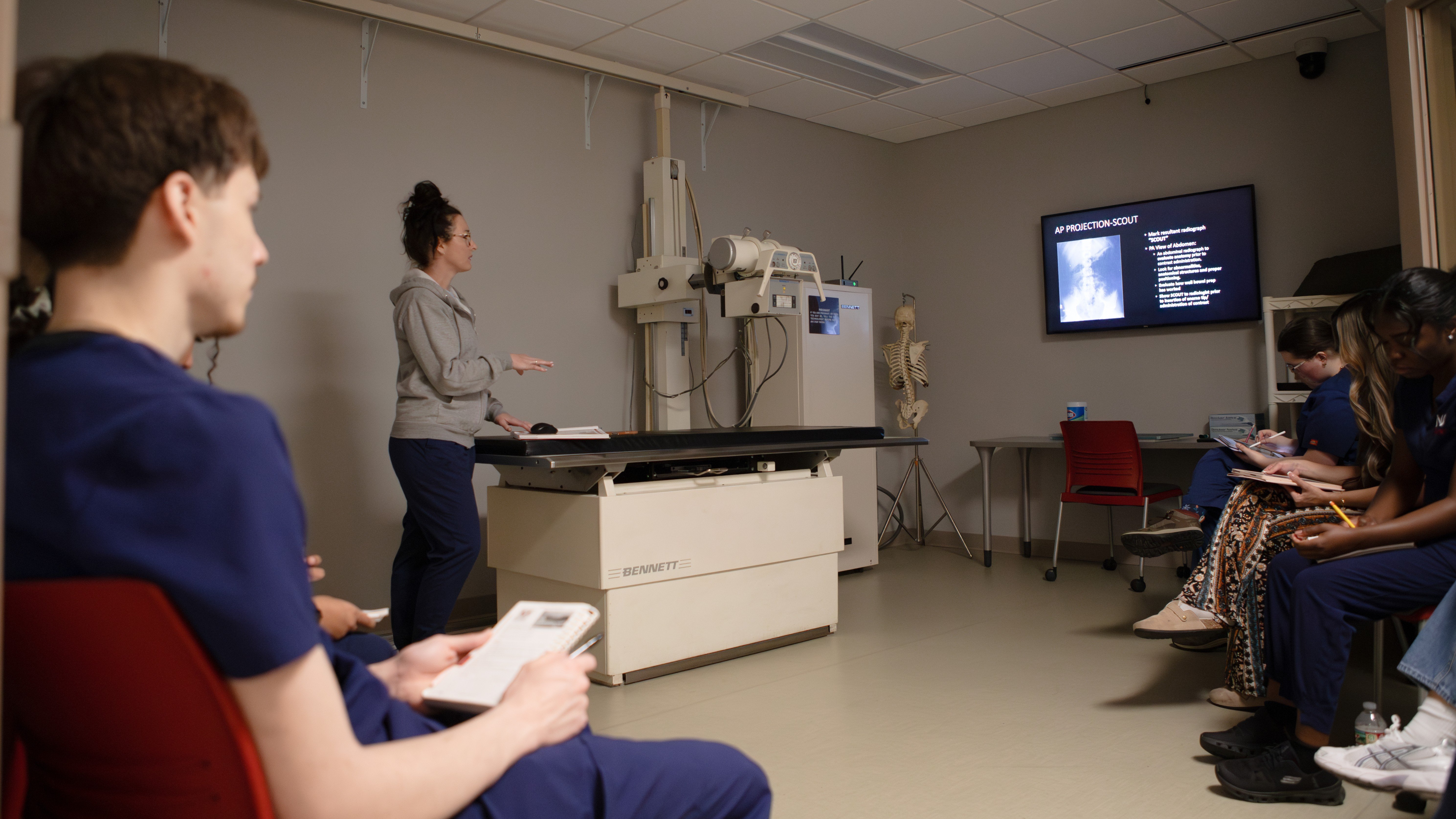
One of the most common misconceptions about healthcare training programs is that the first year is all classroom work and clinicals come later. In Newman University’s Radiologic Technology program, clinical rotations begin during the very first fall semester. Students are in hospital and clinic settings within weeks of starting — not 12 months in.
Early clinical exposure helps students retain didactic knowledge far more effectively by connecting theory to real-world practice almost immediately. Starting clinicals early also means students begin building their professional reputation at clinical sites sooner, which directly contributes to the high job placement rate at graduation.
Your Clinical Rotation Timeline, Semester by Semester
The 21-month rotation schedule is where the program really takes shape. Each semester builds on the last, gradually expanding the types of environments, patient populations, and imaging procedures students encounter. Newman University’s Radiologic Technology program structures this progression carefully, ensuring no two semesters look exactly alike.
1. Fall Semester 1: First Real Patients, First Clinical Site
From the first fall semester, students are placed at a clinical site and begin working under direct, one-on-one supervision from a registered radiologic technologist. This is not observation — students are actively participating in imaging procedures under close guidance.
The focus at this stage is foundational: positioning, patient communication, basic radiographic technique, and radiation safety. Working in a real facility rather than a simulated lab environment means learning happens in context, with the kind of variability that no classroom exercise can replicate. First-semester nerves are real, but the structured supervision is designed to catch and correct errors before they become habits.
2. Spring Semester 2: Expanding Environments (ER, OR, Fluoroscopy)
By the second semester, students rotate through more demanding clinical settings — including the emergency room, the operating room, and fluoroscopy suites. Each environment demands a different skillset and a different level of adaptability.
Fluoroscopy involves real-time imaging rather than static x-rays — essentially a moving picture that requires the technologist to think on their feet and coordinate closely with the radiologist or physician. The ER brings urgency and unpredictability. The OR requires strict sterile technique and close teamwork. Covering all three in a single semester is by design: in actual practice, a technologist can cycle through all of these environments in a single shift.
3. Summer Semester 3: Rural Rotations and Diverse Patient Populations
The summer semester takes students out of the Wichita metro area and into rural clinical settings — including a site in Winfield, Kansas. This is not just a logistical detail. It is a deliberate educational choice.
Rural facilities operate differently from large urban hospitals. Patient demographics shift, available equipment can vary, and technologists often wear more hats. Vaughn noted that rural patient populations present different case mixes, which rounds out a student’s clinical experience in ways that staying in one setting simply cannot. For students who plan to work in smaller Kansas communities after graduation, this exposure is especially practical.
4. Fall Semester 4: Building Competency Across Multiple Radiology Facilities
By the fourth semester, students have rotated through a broad mix of clinical environments. The program works with approximately 13 clinical sites, and most students rotate through roughly half of those — spanning large hospitals, mid-sized facilities, and outpatient clinics.
This variety is intentional. Large hospitals offer high patient volume and complex cases. Medium-sized facilities provide a balance of volume and diversity. Clinics show students what outpatient imaging looks like day-to-day. Each setting adds a new layer of competency and helps students develop the kind of professional flexibility that employers value. By this point in the program, the 51 required competencies are well underway and the pace of clinical skill acquisition accelerates.
5. Spring Semester 5: Completing Clinical Hours and Landing a Job Offer
The final semester is where it all comes together. Students are completing their remaining clinical hours, wrapping up competency requirements, and — in many cases — fielding job offers from the very facilities where they have been rotating.
Some employers hire students as student technologists during this final stretch, offering part-time paid roles that transition into full-time employment after graduation and ARRT certification. This semester is also when the ARRT certification exam becomes the next immediate priority. Graduating from a JRCERT-accredited program is what makes students eligible to sit for that exam — and that eligibility is what unlocks the job market.
How Clinical Hours Stack Up Against the JRCERT Standard
Clinical hours are one of the most concrete ways to measure program quality. The minimum standard exists for good reason — and programs that exceed it tend to produce better-prepared graduates.
JRCERT’s Mandate: Programs Must Exceed 1,200 Clinical Hours
The Joint Review Committee on Education in Radiologic Technology (JRCERT) requires accredited programs to provide students with at least 1,200 clinical hours. This threshold ensures graduates have enough supervised patient contact to be competent and safe practitioners before entering the workforce independently.
Newman University’s program exceeds this standard by a meaningful margin. Students graduate with approximately 1,400 clinical hours — 200 hours above the minimum. That gap matters. Radiology degree requirements across the industry typically range from 1,200 to 1,800 hours depending on state regulations and program length. Landing at 1,400 hours places graduates well within the competent range without unnecessarily extending the program timeline.
1:1 Student-to-Technologist Ratio: What That Means for Your Training
In clinical settings, the program operates at a 1:1 student-to-technologist ratio. Every student is paired with a registered technologist who provides direct supervision and feedback during every patient encounter.
Research in clinical healthcare education consistently shows that lower student-to-instructor ratios accelerate the development of critical thinking, clinical judgment, and procedural confidence. When a student has a dedicated technologist walking through every case with them — explaining decisions, catching positioning errors, discussing technique in real time — the feedback loop is tight and the learning is faster. In a discipline where mistakes involve radiation exposure to patients, that quality of supervision is not optional. It is essential.
JRCERT Accreditation and ARRT Certification Explained
Two organizations matter most in the credentialing world of radiologic technology: JRCERT and ARRT. Understanding what each one does — and how they connect — helps clarify why program accreditation and structure are non-negotiable.
JRCERT Is the Primary Accreditor — But Not the Only ARRT-Recognized One
JRCERT is the independent agency that evaluates and accredits radiologic technology programs across the United States. Its standards cover curriculum design, clinical education quality, patient safety protocols, and faculty qualifications. A JRCERT-accredited program has been independently verified to meet rigorous national benchmarks.
The American Registry of Radiologic Technologists (ARRT) is the national certification body that administers the board exam and issues the credential most employers require. ARRT recognizes JRCERT as a primary accreditor, though graduates of other recognized bodies may also be eligible to sit for the exam. In practice, JRCERT accreditation remains the most widely respected pathway — and graduating from a JRCERT-accredited program is the most direct route to ARRT eligibility and employment as a credentialed radiologic technologist.
Admission Requirements: What You Need to Apply
Getting into the program requires meeting a specific set of academic and procedural requirements. The bar is designed to be achievable — but competitive enough to select students who are genuinely ready for the pace of a clinical healthcare program.
GPA Requirements: 2.75 Cumulative Minimum, 3.0 Competitive Benchmark
The minimum cumulative GPA for admission is 2.75. This is the floor — the point below which an application will not be considered. However, with a competitive applicant pool, the realistic target is higher. A 3.0 GPA is the benchmark that meaningfully strengthens an application.
Tim Cho, Dean of the School of Healthcare Professions at Newman University, was direct about this during a recent information session: the minimum GPA gets the application in the door, but a higher cumulative GPA is what separates strong candidates from borderline ones. Academic performance in prerequisite coursework is especially scrutinized, since it signals how well a student will handle the program’s demanding science and clinical content. Students who complete prerequisites at Newman also receive a small application advantage — a recognition that the rigor of the institution’s academics is a known quantity.
Application Window: Opens January 1st, Deadline March 1st
The application window opens January 1st and the deadline is March 1st. After the deadline, qualified candidates are invited to a panel interview. Interviews last approximately 30 minutes and every candidate receives the same structured questions — making preparation and genuine self-presentation the primary differentiators. The process is thorough but fair, giving the program a chance to assess qualities that grades alone cannot capture.
How to Strengthen Your Application
The program accepts a limited number of students per cohort. With roughly 70 applicants competing for those spots in a recent admissions cycle, the selection process is genuinely competitive. Getting in means doing more than hitting the minimum requirements.
A few strategies that make a real difference:
- GPA above 3.0 — the higher, the better
- Strong references — from supervisors, professors, or healthcare professionals who can speak to relevant abilities, not just personal character
- Shadowing experience — spending time in a radiology department before applying demonstrates genuine interest and realistic expectations
- Prerequisites completed at Newman — earns a small but meaningful application bump
- Conditional acceptance is possible — students finishing prerequisite courses over the summer can receive conditional acceptance, provided final transcripts confirm completion with required grades
The Kansas Promise Scholarship Can Cover Your Costs
Tuition costs are one of the most common barriers to entering healthcare training programs. For Kansas residents, the Kansas Promise Scholarship directly addresses that barrier — and it applies specifically to programs like Radiologic Technology.
Last-Dollar Coverage: Tuition, Fees, and Books
The Kansas Promise Scholarship is a “last-dollar” scholarship — meaning it fills the gap after other financial aid, grants, and institutional scholarships have already been applied. The result can be near-complete coverage of tuition, required fees, and program materials, including books.
It is administered through the Kansas Board of Regents, not Newman University directly, and it requires a separate application each semester. Newman’s financial aid office can help with that process and ensure all requirements are met on time. One important detail: every course taken in a given semester must count toward the degree to qualify for that semester’s scholarship coverage. Students taking courses outside their degree plan risk losing eligibility for that term.
The Two-Year Live-and-Work Requirement in Kansas
To receive the Kansas Promise Scholarship, recipients must agree to live and work in Kansas for two consecutive years after graduation. For most rad tech graduates in the state, this is not a hardship — the Kansas healthcare job market is active, and the two-year commitment aligns naturally with the early career phase.
For students who were already planning to stay in Kansas, the scholarship is essentially free money layered on top of existing financial aid. For those who are unsure about long-term plans, it is worth weighing carefully before applying. The obligation is real and enforceable.
Where This Degree Can Take Your Career
An associate’s degree in Radiologic Technology is not a ceiling — it is a launchpad. The credential opens doors to direct employment and serves as the foundation for advancement into specialized imaging modalities.
Typical Kansas Salaries: Entry-Level Roles Starting Between $40,000 and $58,000
Kansas radiologic technologists earn an average annual salary ranging from approximately $58,700 to $85,000, with entry-level positions typically starting between $40,000 and $58,000 per year, and top earners potentially exceeding $100,000. For a two-year associate’s degree, that is a strong return on educational investment — especially when programs like the Kansas Promise Scholarship can bring out-of-pocket costs close to zero.
Salaries scale with experience, specialization, and work setting. Hospital-based technologists, particularly those who cross-train into higher-demand modalities, tend to reach the upper end of the pay range more quickly. Some recent Newman University graduates were hired directly into CAT scan and cardiovascular roles — advanced positions that typically come with higher starting pay.
Advancing Into CAT Scan, MRI, Mammography, and Beyond
The general radiologic technology credential is the prerequisite for most advanced imaging specialties. From there, technologists can pursue additional training in:
- CT (CAT Scan) — one of the most common career progressions, with growing demand driven by diagnostic imaging volume
- MRI — a rapidly expanding field with specialized certification pathways
- Mammography — a high-demand specialty with a dedicated ARRT certification
- Cardiovascular Imaging — an advanced, procedure-heavy specialty requiring additional education
- Radiation Therapy — treats cancer patients using therapeutic radiation; requires a separate degree program
- Nuclear Medicine — uses radioactive tracers for diagnostic imaging; also a separate specialty pathway
Many of these specializations require additional post-primary education and ARRT certification beyond the associate’s degree — not another full college program. The radiologic technology credential does the heavy lifting, and the advanced modalities build on top of it.
Start Shadowing Now — Applications Open Every January 1st
The single most actionable step for anyone seriously considering this field is to shadow a radiologic technologist before applying. Most hospitals and imaging centers allow prospective students to shadow with minimal paperwork — typically just HIPAA compliance forms. Local facilities in the Wichita area, including Wesley Medical Center, Rock Regional, and Ascension St. Teresa, are all options worth contacting directly.
Shadowing does two things at once: it confirms whether the day-to-day reality of the job matches expectations, and it gives applicants a concrete experience to reference during the panel interview. Admissions reviewers notice the difference between candidates who have observed the field firsthand and those who are going on secondhand impressions alone.
With the application window opening January 1st and a March 1st deadline, there is enough runway to shadow, complete any remaining prerequisite coursework, build strong references, and put together a competitive application package. The program fills its seats from a pool of roughly 70 applicants — which means preparation is the variable that matters most.
For anyone ready to take next steps, Newman University offers healthcare degree programs built around hands-on clinical training, with faculty and advisors available to help map out a clear path from first inquiry to graduation.
Newman University
3100 McCormick
Wichita
Kansas
67213
United States


