Why Content Velocity Is the New Marketing KPI
Chicago, United States – October 22, 2025 / Aprimo /
The Shift from Engagement Rates to Operational Speed Is Reshaping Competitive Advantage
Content velocity has emerged as the most critical marketing KPI, measuring how quickly organizations can ideate, create, and deploy high-quality content at scale.
-
Traditional metrics like page views and engagement rates fail to capture the speed-to-market advantage that drives competitive differentiation.
-
Companies with high content velocity achieve faster campaign launches and higher content ROI than slower competitors.
-
AI-powered content operations enable enterprises to balance rapid production with quality governance and brand consistency.
The organizations that master content velocity will dominate their markets while others struggle with outdated measurement frameworks.
Here’s what’s changing in marketing right now: while most teams are still obsessing over click-through rates and time-on-page, smarter organizations have shifted their focus to something completely different. They’re asking themselves one simple question: how fast can we turn an idea into content that actually gets published?
Research shows that 78% of marketing leaders now use AI in at least one area of their operations, reflecting the growing emphasis on operational efficiency and speed. Yet most marketing teams remain trapped in measurement frameworks designed for a bygone time, when content production moved at a glacial pace and campaigns had months-long lead times.
Bottom line? Content velocity is the new kingmaker. Engagement metrics still matter, but if you can’t get your content out the door fast enough, those metrics won’t matter much at all.
What Is Content Velocity, and Why Does It Matter?
Content velocity measures the speed at which your organization can move from concept to published content while maintaining quality standards. It encompasses three critical components: ideation speed, production efficiency, and deployment agility.
Think about it this way: traditional metrics tell you how well your content performed after you published it. Velocity tells you whether you can actually show up to the conversation in the first place. When news breaks or a competitor makes a move, your content velocity is what determines if you’re in the game or stuck on the bench.
Organizations that can rapidly test, iterate, and scale content operations are capturing market share while others perfect their quarterly planning cycles.
Modern buyers don’t wait for your content calendar. They research solutions, compare options, and make decisions on their timeline, not yours. Organizations with high velocity can match this pace, delivering relevant content when prospects are actively seeking answers.
Why Do Traditional Marketing KPIs Fall Short?
Here’s the problem with traditional KPIs: they’re backward-looking. Sure, page views and social shares tell you what happened yesterday. But they don’t tell you a thing about whether your team can actually move fast enough to capitalize on what’s happening today.
Picture this: your biggest competitor drops a major product announcement Tuesday morning. If you’re measuring success with traditional KPIs, you’re tracking how your response performs three weeks from now. If you’re measuring velocity, you’re asking: can we get a solid competitive analysis live by Thursday? That’s the difference.
This operational blindness has real consequences. Companies focused on traditional metrics optimize for content that performs well in isolation but struggle to maintain relevance in fast-moving markets. They produce beautiful content that arrives too late to influence decisions or capitalize on trends.
Traditional metrics also fail to account for content efficiency. A blog post that takes six weeks to produce and generates 10,000 views delivers very different business value than content created in two days that achieves the same reach.

The disconnect becomes even more pronounced in B2B environments where buying cycles are complex and decision-makers consume content across multiple touchpoints. Traditional attribution models break down, but velocity provides a clear indicator of your ability to influence these extended journeys.
How Does Content Velocity Drive Real Business Results?
Want to know why fast-moving companies keep winning? It’s simple: they show up when buyers are actually looking for answers. And when you look at how modern buyers research solutions, the connection between speed and results becomes pretty obvious.
Buyers complete 70% of their research before engaging with sales teams. Companies with high velocity can provide answers at every stage of this self-directed journey, while slower competitors lose influence to more responsive alternatives.
This is where things get interesting. Fast teams aren’t just publishing quickly—they’re testing, learning, and scaling what works while their competitors are still in the planning phase. That iterative edge compounds over time, creating content that consistently outperforms what slower teams eventually produce.
Real business impact manifests in measurable ways. Companies with high velocity report faster lead generation, shorter sales cycles, and higher content ROI compared to organizations using traditional approaches. These improvements reflect the direct connection between operational speed and market effectiveness.
Content velocity also enables more sophisticated personalization and segmentation strategies. When you can rapidly produce and deploy content variations, you can test different messages, formats, and approaches across audience segments.
What Are the Three Pillars of Enterprise Content Velocity?
Sustainable content velocity on an enterprise scale requires balancing three essential elements: speed, quality, and strategic alignment. Organizations that optimize for speed alone typically sacrifice quality or strategic relevance, while those focused exclusively on quality often miss market opportunities entirely.
How Do You Balance Speed and Quality?
The speed-quality tension is a common enterprise content velocity challenge. Traditional approaches assume these elements compete, but leading organizations treat them as complementary capabilities that reinforce each other.
Instead of perfect execution, quality emphasizes consistency, brand alignment, and audience relevance. Content that meets brand standards and provides clear value often outperforms perfectly polished pieces that arrive too late to influence decisions.
Systematic approaches to quality enable speed. Content templates, brand guidelines, and approval workflows reduce the time spent on formatting and compliance while ensuring consistent output. When quality processes become automated and embedded in production workflows, they accelerate rather than hinder content velocity.
How Do You Maintain Strategic Alignment at Speed?
Look, speed without direction is just chaos with a deadline. You can pump out content all day long, but if it doesn’t connect with what your audience actually needs or support what your business is trying to accomplish, you’re just making noise faster.
Effective alignment starts with content strategy frameworks that guide rapid decision-making. When teams understand target audiences, key messages, and priority objectives, they can make strategic choices quickly without extensive review cycles.
Data-driven feedback loops maintain alignment over time. Regular analysis of content performance, audience engagement, and business impact helps teams adjust direction without slowing production. Strategic alignment becomes a dynamic capability rather than a static planning exercise.
How Do You Scale Content Operations Systematically?
Scalable content operations transform velocity from individual productivity to organizational capability. Sustainable velocity requires systems, processes, and technologies that support increased output without proportional increases in resources or complexity.
Standardized workflows eliminate bottlenecks and reduce coordination overhead. When content production follows consistent processes, teams can work in parallel, reduce review cycles, and maintain quality standards even as volume increases. This systematic approach enables predictable scaling rather than chaotic expansion.
Technology integration amplifies human capabilities rather than replacing them. The most effective content velocity strategies combine automated efficiency with human creativity, strategic thinking, and relationship building.
How Is AI-Powered Content Changing the Velocity Game?
Let’s talk about AI. We’re not talking about replacing human creativity here—we’re talking about enabling production speeds that would be completely impossible if you were doing everything manually. AI changes what’s possible when it comes to getting content out the door.
The AI-powered content creation market is projected to reach $10.6 billion by 2033, reflecting widespread adoption across enterprises seeking competitive advantages. AI excels at handling routine content production tasks that traditionally consumed significant time and resources. Automated research, initial draft creation, optimization suggestions, and distribution planning free teams to focus on strategy, creativity, and relationship building.
The compound effect of AI integration creates exponential velocity improvements. When AI handles initial content creation, editors can focus on refinement and strategic alignment. When AI manages distribution optimization, teams can concentrate on producing more content rather than managing technical details.

However, the most successful AI implementations balance automation with human oversight. AI-powered content enables velocity, but human judgment ensures relevance, accuracy, and brand alignment.
Intelligent content systems also enable more sophisticated measurement and optimization. AI can analyze content performance patterns, identify successful formats, and recommend adjustments. Continuous optimization ensures that increased velocity drives improved results rather than just higher volume.
What Are the 5 Essential Metrics for Tracking Content Velocity?
Measuring content velocity requires different metrics than traditional content marketing KPIs. These five essential measurements provide comprehensive visibility into your organization’s content production capabilities:
1. Concept-to-Publication Time
Track the average time from initial content idea to live publication. This metric reveals bottlenecks in your production process and helps identify opportunities for workflow optimization. Focus on establishing consistent benchmarks for different content types.
2. Content Production Capacity
Measure your team’s ability to produce content consistently over time. Consider both quantity metrics (posts per week, assets per month) and quality indicators (approval rates, revision cycles). Sustainable capacity metrics prevent burnout while ensuring reliable output.
3. Response Speed to Market Events
Track how quickly your team can produce relevant content following industry developments, competitive moves, or trending topics. This metric directly measures your ability to stay relevant and influence conversations when they matter most.
4. Content Reuse and Optimization Rates
Measure how effectively you repurpose and optimize existing content across different formats and channels. High-velocity organizations typically maximize the return on creative investment by generating multiple derivative pieces from each primary content asset.
5. Cross-Team Collaboration Efficiency
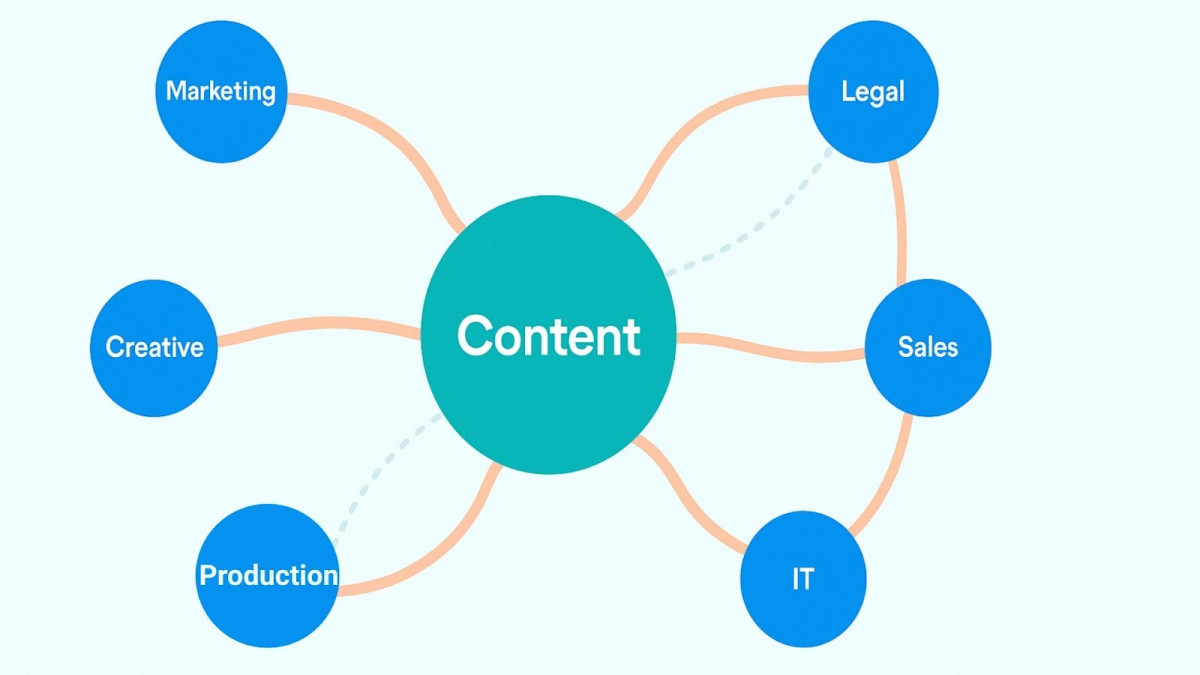
Track how well different teams (marketing, sales, product, legal) collaborate on content production. Measure review cycles, approval times, and stakeholder satisfaction to ensure velocity doesn’t come at the expense of organizational alignment.
How Do You Build Your Content Velocity Strategy?
Building sustainable content velocity starts with a clear assessment of your current capabilities and bottlenecks.
Map your existing content production process from initial ideation through final publication. Identify steps that consistently cause delays, require excessive reviews, or depend on limited resources. These bottlenecks become your priority areas for optimization and automation.
Establish clear governance frameworks that enable speed without sacrificing quality or brand consistency. Define approval workflows, quality standards, and escalation processes before increasing production velocity. Prevention systems are more effective than post-production corrections.
Invest in integrated technology solutions that connect content planning, production, and distribution. Disconnected tools create friction and coordination overhead that slows velocity. Look for platforms that provide unified workflows from concept to deployment.
Finally, get your cross-functional relationships sorted out. Legal, compliance, product, sales—these teams can either be your biggest allies or your biggest bottlenecks. The trick is building those relationships proactively and setting up pre-approved frameworks so you’re not starting from scratch every single time you need sign-off.
FAQ
How do you maintain brand consistency at high content velocity?
Brand consistency at speed requires automated brand guideline enforcement, content templates, pre-approved messaging frameworks, and AI-powered compliance checking. The goal is to embed quality controls into rapid production workflows rather than relying on manual review processes.
Can small marketing teams achieve high content velocity?
Yes, small teams can achieve excellent content velocity through automation, strategic focus, and efficient workflows. AI-powered content creation, repurposing strategies, and streamlined approval processes enable small teams to compete effectively with larger organizations that rely on traditional approaches.
What role does content velocity play in competitive advantage?
Content velocity creates sustainable competitive advantages by enabling faster market response, more comprehensive audience engagement, and continuous optimization. Organizations with high velocity can test approaches, iterate based on results, and scale successful strategies while competitors are still planning their initial campaigns.
Accelerate Your Content Velocity
The marketing organizations that thrive will master content velocity as their primary competitive advantage. By measuring and optimizing how quickly they can turn ideas into market-ready content, these companies will capture opportunities that slower competitors miss entirely.
Success demands intelligent systems that balance speed with quality, strategic alignment, and measurable business impact. The organizations that invest in AI-powered content operations platforms will achieve the velocity necessary to dominate their markets. Aprimo’s content operations platform enables enterprises to master content velocity through intelligent automation, streamlined workflows, and integrated performance optimization.


Contact Information:
Aprimo
230 W Monroe Street, Suite 1200
Chicago, IL 60606
United States
Aprimo Support
https://www.aprimo.com/